
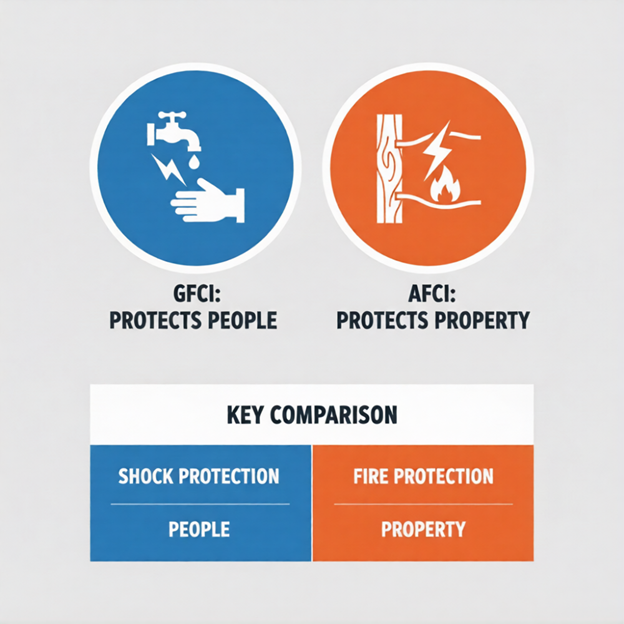
In the world of electrical safety, two acronyms stand out: GFCI (Ground Fault Circuit Interrupter) and AFCI (Arc Fault Circuit Interrupter). While both are designed to shut off power in an emergency, they detect different types of dangerous electrical behavior. Understanding these differences can help you identify why a breaker is tripping and ensure your home meets modern safety codes.
What is a GFCI? (Protection Against Shock)
A GFCI is specifically designed to prevent electrocution. It monitors the flow of electricity through a circuit. If it detects that electricity is leaking out of the wires perhaps through water or through a person’s body it shuts off the power instantly.
- What it detects: Ground faults (electricity escaping its path).
- Response time: Less than 1/30th of a second.
- Primary goal: To save lives by preventing heart failure or burns from electrical shocks.
- Common locations: Kitchens, bathrooms, garages, and outdoor areas where water is present.
What is an AFCI? (Protection Against Fire)
An AFCI is designed to prevent electrical fires. It uses advanced electronics to “listen” to the electricity flowing through the wires. It looks for dangerous arcs sparks that occur when electricity jumps between loose connections or damaged wires.
- What it detects: Arcing (sparks behind walls or inside cords).
- The danger of arcs: An arc can reach temperatures of over 10,000°F, which can easily ignite wood studs or insulation inside your walls.
- Primary goal: To prevent house fires caused by faulty wiring or damaged appliance cords.
- Common locations: Bedrooms, living rooms, dining rooms, and most other dry living spaces.
Key Comparison Table
| Feature | GFCI (Ground Fault) | AFCI (Arc Fault) |
| Main Purpose | Prevent Electrocution/Shock | Prevent Electrical Fires |
| What it senses | Current leakage to ground | Dangerous sparking (arcing) |
| Required by Code | Wet/Damp Areas | General Living Areas/Bedrooms |
| Available as | Outlet or Breaker | Mostly Breaker (sometimes Outlet) |
| Safety Target | Your Body | Your House/Structure |
Why You Need Both in Your Home
Modern electrical codes (NEC) now require both types of protection in residential homes. They are not interchangeable. For example:
- An AFCI might not trip if you drop a hair dryer in a sink (that requires a GFCI).
- A GFCI will not trip if a mouse chews through a wire in your attic and starts a fire (that requires an AFCI).
Today, manufacturers also offer Dual-Function breakers that provide both GFCI and AFCI protection in one unit. These are often used in laundry rooms or kitchens to meet all safety requirements at once.
Troubleshooting: Why is My GFCI or AFCI Tripping?
If one of these devices keeps shutting off, it is a warning sign that shouldn’t be ignored:
- GFCI Tripping
- Moisture: Check if there is water or high humidity in the outlet box.
- Faulty Appliance: A “leaky” appliance, like an old refrigerator or power tool, may be causing a ground fault.
- AFCI Tripping
- Damaged Cord: Check for furniture pinching a lamp cord or a frayed vacuum wire.
- Loose Connections: A loose wire behind a wall switch can cause arcing that trips the AFCI.
- Incompatible Electronics: Some older vacuum cleaners or cheap power adapters create “normal” sparks that can confuse an AFCI (nuisance tripping).
Conclusion
GFCIs and AFCIs are the silent guardians of your home’s electrical system. While one keeps you safe from shocks in the bathroom, the other prevents fires while you sleep in your bedroom. Ensuring these devices are properly installed and tested is a vital part of home maintenance. If you live in an older property, upgrading your panel with AFCI/GFCI protection is one of the best investments you can make for your family’s safety.