
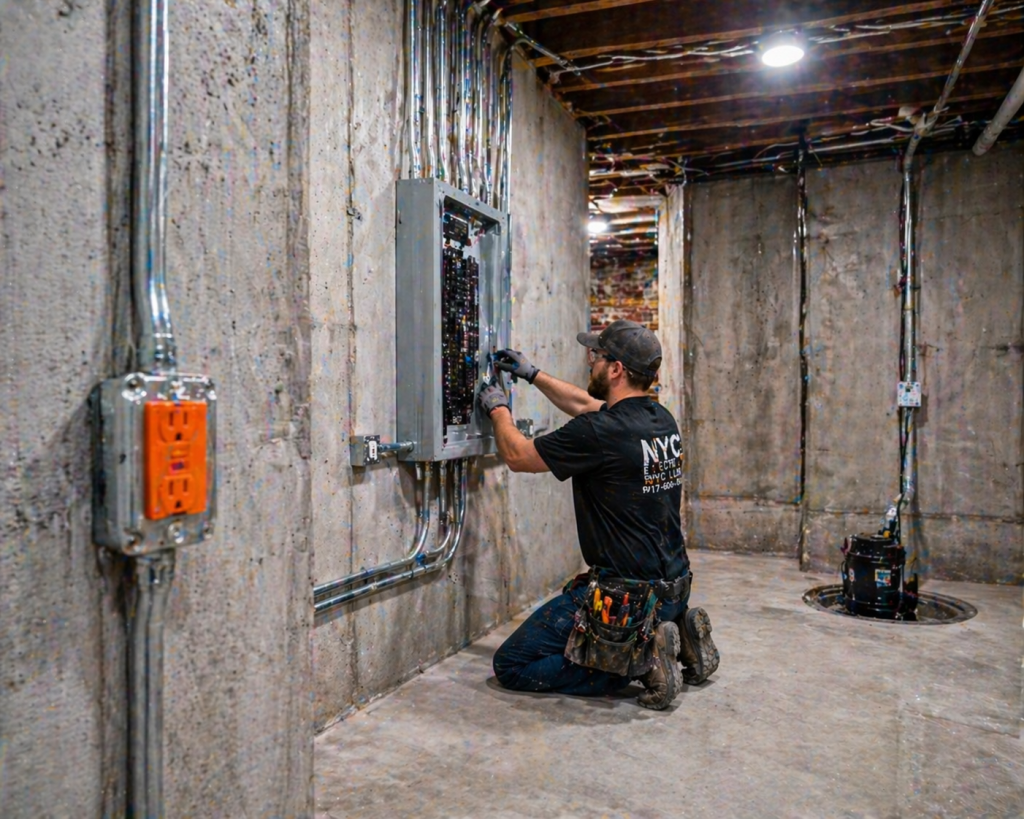
Finishing a basement in a NYC brownstone, rowhouse, or Queens-Brooklyn two-family is one of the highest-value renovations you can do on paper. In practice, it is also one of the most code-intensive. Basements and cellars are classified as damp or wet locations under the NEC and the NYC Electrical Code, which means the electrical rules are stricter, the inspection checklist is longer, and the shortcuts a contractor might take upstairs will fail down here.
This guide breaks down what the NYC Electrical Code actually requires for basement and cellar electrical work GFCI coverage, sump pump circuits, outlet and lighting placement, wiring methods that hold up in moisture, the inspection and permit path, and the difference between a cellar (which often cannot be legally habitable) and a basement (which often can, with work).
Basement vs Cellar in NYC: A Code Distinction That Matters
In most of the country, ‘basement’ and ‘cellar’ are interchangeable. In NYC, they are legally different, and the difference dictates what electrical work is even allowed to happen down there.
- Basement — at least 50% of its vertical height above the adjoining finished grade. Can often be legalized as habitable space with the right filings and work.
- Cellar — more than 50% of its vertical height below adjoining finished grade. Generally cannot be legalized as sleeping or living space, regardless of how nicely it is finished.
This distinction matters electrically because: (a) a cellar legalized as a rec room has very different GFCI, egress lighting, and outlet count requirements than a basement converted to a bedroom; and (b) finishing a cellar as habitable space without the right use classification creates a trail of non-compliant electrical work that surfaces at the worst possible time during a home sale inspection, an insurance claim, or a DOB violation sweep.
Before any electrical plan is drawn, the use classification should be settled. Our guide to the NYC electrical permit process covers how the DOB intake treats these filings.
GFCI Requirements: Where They Apply and Why
The short version: the NEC now requires GFCI protection for virtually all 125V receptacles in basements and cellars, not just the ones near obvious water sources. This is a significant change from older code editions. If your existing basement was wired under the 2014 or older code and has non-GFCI outlets, it was compliant when installed but any new work triggers the current requirement. Our full explainer on what a GFCI outlet is and where it’s required covers the broader picture; below are the basement-specific rules.
Where GFCI Is Mandatory in NYC Basements
- All 125V, 15A and 20A receptacles throughout the basement and cellar.
- Laundry room outlets washer, dryer, laundry sink area.
- Any receptacle within 6 feet of a sink, laundry tub, sump pump pit, or floor drain.
- Bar sink areas, wet bars, or kitchenettes in finished basements.
- Outlets serving bathroom additions covered as a separate bathroom requirement.
- Outlets in unfinished storage areas and mechanical rooms.
- Dedicated circuits for sump pumps and dehumidifiers (with specific exceptions see below).
The Sump Pump GFCI Exception Every Homeowner Should Know
This trips up more NYC basement owners than any other single code point. A GFCI that trips while you are on vacation means your sump pump stopped working and your basement flooded.
The NEC allows, but does not require, a single-outlet dedicated sump pump receptacle to be non-GFCI IF it is labeled as such, installed on a dedicated circuit, and the sump pump is a hard-wired or single-plug appliance. The catch: many NYC inspectors require GFCI on sump pumps anyway, and some require GFCI with a specific type of pump that will not nuisance-trip.
Best practice is either a dedicated GFCI circuit with a premium-grade pump rated to not cause nuisance trips, or a GFCI circuit with a backup battery sump pump that activates if the primary pump loses power. Whichever path, the outlet must be clearly labeled and, if on a non-GFCI dedicated circuit, explicitly approved in the DOB filing.
Dedicated Circuits: What Needs Its Own Run
A finished basement in NYC typically requires more dedicated circuits than most homeowners expect. Running everything off the existing two-circuit basement wiring the house came with is the fastest way to trip breakers, burn out equipment, and fail inspection.
| Equipment / Area | Dedicated Circuit? | Amperage |
| Sump pump | Yes (strongly recommended) | 15A or 20A |
| Ejector pump / sewage pump | Yes | 15A or 20A |
| Dehumidifier (permanent install) | Yes (best practice) | 15A |
| Washer | Yes | 20A |
| Gas dryer | Yes | 15A |
| Electric dryer (if basement laundry) | Yes | 30A 240V |
| HVAC air handler / furnace | Yes | 15A or per unit |
| Water heater (electric, if relocated) | Yes | 30A 240V |
| Home gym equipment (treadmill, etc.) | Yes (recommended) | 20A |
| Freezer / beverage fridge | Yes (recommended) | 15A or 20A |
| General outlets (rec area) | Shared 20A circuit OK | 20A |
| Lighting | Separate from outlet circuit | 15A |
Most basement finishing projects require a subpanel installed near the work area to avoid running a dozen long circuits back to the main panel. We handle subpanel installation as part of breaker panel work typically the first physical electrical step in a basement finish.
Moisture and Wiring Methods: What the Code Actually Requires
Standard NM-B (Romex) cable is approved for dry locations only. Basements that are legitimately dry year-round can use NM-B throughout. Basements that are damp even occasionally damp require different methods.
Dry, Damp, and Wet Location Definitions
- Dry location normally free from dampness. Standard NM-B is fine.
- Damp location subject to moderate moisture from condensation, occasional leaks, high humidity. Requires UF cable, MC cable, or conductors in conduit.
- Wet location subject to direct water contact or saturation. Requires conductors in conduit, sealed connections, weather-resistant outlets.
Most NYC basements in brownstones, old frame houses, and buildings near waterways fall under damp at minimum. The specific wiring method should be determined in the DOB filing before any work begins. Inspectors will reject NM-B in a basement they classify as damp, which is a painful rework if the wiring is already in the walls.
The parallel to outdoor electrical work is direct — outdoor boxes, cellar boxes, and garage boxes all need to be rated for their actual environment. We cover the logic in detail in our outdoor electrical box weatherproofing guide — the same NEMA rating principles apply in a wet basement.
Conduit vs Cable in NYC Basements
- EMT (Electrical Metallic Tubing) thin-wall steel conduit, NYC favorite for basement work, easy to install and inspect.
- PVC conduit good for underground or direct-contact-with-concrete runs, also fine for general basement use.
- Flexible MC (Metal Clad) cable approved in damp locations, faster to install than conduit, NYC inspectors generally accept it.
- Liquid-tight flexible conduit for sump pits, pumps, or any transition into a wet location.
Outlet and Lighting Placement Rules
Outlet Spacing and Placement
- Every usable wall section 2 feet or wider must have a receptacle no point along the wall more than 6 feet from an outlet.
- At least one receptacle in each unfinished basement area, even if not habitable.
- One receptacle in each laundry area.
- Outlets must be at least 18 inches above finished floor in damp locations with known flooding history.
- Bathroom outlets (if adding a basement bathroom) at their own dedicated 20A circuit, GFCI protected, minimum one within 3 feet of the sink.
Lighting Placement
- At least one lighting outlet controlled by a wall switch at the entry to the basement.
- Additional switched lighting in every finished room and each unfinished storage area.
- Emergency or egress lighting at the foot of basement stairs best practice, sometimes required depending on use classification.
- All damp-location lighting must be listed for damp locations (most residential recessed cans are check the label).
For the actual lighting selection, our lighting installation services page covers the fixture options. For safety-inspection perspective on the pre-finish stage, an electrical safety inspection of the existing basement wiring before you plan the finish saves a significant amount of rework later.
Grounding, Bonding, and Metal Systems in Basements
Basements concentrate the building’s metallic systems water mains, gas mains, sewer connections, sometimes the main service ground. All of these must be properly bonded together to prevent differential-voltage hazards. Our grounding and bonding guide covers the broader principle. In a basement specifically, inspectors will check:
- Metal water piping bonded at the point of entry.
- Gas piping bonded at the appropriate point (typically via the equipment ground in the gas appliance circuit).
- Metal HVAC ductwork bonded where required.
- Main panel bonding verified and correctly sized bonding conductors in place.
- Any metal conduit runs properly bonded at both ends.
Grounding and bonding problems that exist upstairs often originate in the basement. If the basement panel or meter is going to be touched as part of the finish, the grounding system should be re-verified as part of the work.
Smoke and Carbon Monoxide Detectors in Basements
Any finished basement in NYC requires at least one smoke detector and one CO detector on the basement level, interconnected with the detectors on other floors. Our detector wiring and placement guide covers the specific rules. Critical points for basements:
- Smoke detector placement away from HVAC supply vents (false alarms from dust).
- CO detector placement per manufacturer height recommendations (CO is roughly the same density as air, so low placement is fine).
- Hardwired with battery backup per NYC code, not battery-only.
- Interconnection with existing floors so that a basement alarm triggers all detectors in the house.
- Combination detectors acceptable and often preferred in basements where space is constrained.
Permits, Inspections, and DOB Filings
Basement electrical work above trivial scope (adding circuits, installing a subpanel, running new cable) requires a DOB electrical permit. There is no informal path. The filing sequence:
- Licensed NYC electrician files the electrical work through DOB eFiling.
- Work proceeds after the permit is approved.
- Rough-in inspection by a licensed electrical inspection agency (LEIA) before drywall goes up.
- Final inspection after drywall, devices installed, and everything is powered.
- Paperwork submitted back to the DOB to close out the filing.
Skipping this creates the exact situation that causes DOB electrical violations to appear at the worst time — usually during a future sale or renovation filing. Those violations block new permits until resolved, which often means opening walls you’ve just finished to re-inspect the work.
Common Basement Electrical Mistakes We See in NYC
- NM-B cable used throughout a damp basement because ‘it worked upstairs.’ Fails inspection and requires rewiring.
- Sump pump on a GFCI outlet with no backup the GFCI nuisance-trips during a storm, no one notices, basement floods.
- Outlets mounted at 12 inches in a basement with flooding history. Should be 18+ inches above finished floor.
- Mini-splits and dehumidifiers chained off a single 15A circuit. Result: constant breaker trips in summer.
- Subpanel installed without proper bonding/neutral separation major violation, often caught at final inspection.
- Bathroom added without a dedicated 20A GFCI circuit for the receptacles.
- Recessed cans rated for dry locations only, installed under unfinished joists that condense moisture in summer.
- Finishing over unpermitted work from a prior owner. The next inspection surfaces it.
Frequently Asked Questions
Do I need a permit to add a single outlet in my unfinished basement?
Technically yes, if the outlet requires new wiring back to the panel or extends an existing circuit in a way that changes the circuit’s rating or coverage. NYC treats any permanent electrical alteration as permit work. A simple device replacement (swapping a receptacle for an identical new one on existing wiring) is generally fine without a permit.
Can I run Romex in my basement if it’s always dry?
If the DOB filing classifies the basement as dry and the inspector agrees, yes. In a NYC brownstone or frame house, most basements get classified as damp at minimum. The safer default is MC cable or conduit.
My sump pump keeps tripping the GFCI. What do I do?
Usually one of three things: the pump is failing and drawing abnormal current, the GFCI device itself is old and over-sensitive, or there is moisture intrusion at the plug or in the outlet box itself. A licensed electrician can diagnose in one visit. Do not just replace the GFCI with a standard outlet — that exit strategy violates code and carries liability if someone is injured.
Do I need arc-fault protection (AFCI) in a basement?
Current NEC requires AFCI on most 120V branch circuits in habitable basement areas. Unfinished storage/mechanical areas may be exempt. For finished basement bedrooms, living areas, rec rooms — AFCI is required. Most modern panels use combination AFCI/GFCI breakers that satisfy both.
What’s the realistic cost for basement electrical work in NYC?
A basic finished-basement electrical scope — subpanel, 6–8 circuits, 15–20 outlets, lighting, smoke/CO interconnect, sump pump circuit, and the DOB filing — typically runs $8,000–$18,000 in NYC depending on run lengths, panel location, and whether a Con Edison service upgrade is needed. Full bathroom additions, home gyms, or HVAC electrical work push the number higher.
Bottom Line
A finished NYC basement adds significant usable square footage and real resale value, but the electrical work is where contractors most often cut corners and where inspectors most often catch them. GFCI coverage, correct wiring methods for the moisture level, dedicated circuits for equipment that needs them, proper grounding, interconnected alarms, and a clean DOB filing trail are non-negotiable — not because the city is being difficult, but because basements are exactly where electrical shortcuts become electrical fires.
Plan the electrical scope before the framing plan is finalized. Run the DOB filing in parallel with the architectural permit. And do not let a general contractor subcontract the electrical work to an unlicensed helper it will show up at final inspection every time.
A&B Electric Wiring handles basement and cellar electrical work across Manhattan, Brooklyn, Queens, the Bronx, and Staten Island, including the DOB filing, subpanel installation, and final inspection. Get in touch for a basement-specific scope and quote, or browse our full residential electrical services for related work.