
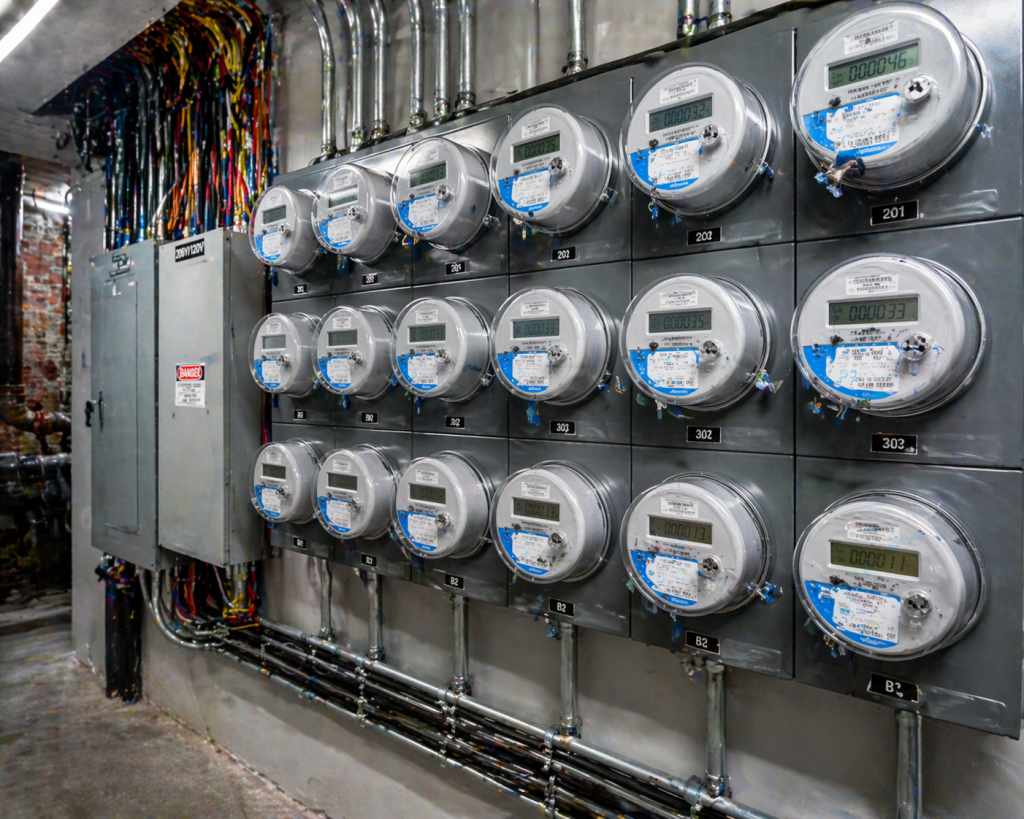
If you own a NYC rental building, a multi-family brownstone, or a condo association or you are planning to sub-metering is one of those upgrades that sounds simple on paper and gets complicated fast in practice. One master meter, a dozen tenants, one rising Con Edison bill, and the question eventually comes up: why are we not billing each unit individually?
The short answer is that you can, but New York regulates sub-metering more tightly than almost any other state. The PSC (Public Service Commission) requires an order before you can bill tenants for their share. The DOB requires proper filings before the equipment goes in. And Con Edison has its own opinion about service capacity and how it connects to the rest of the building.
Here is the complete breakdown what sub-metering actually is, when it pays off, what it costs in NYC, and the regulatory path you cannot skip.
What Is Electrical Sub-Metering?
A sub-meter is a secondary electrical meter installed downstream of the building’s main Con Edison meter. It measures the electricity consumed by a single tenant, unit, or commercial space inside a larger property that has one master utility account.
Instead of Con Edison billing each apartment directly (which requires individual direct-metered service), the building owner is billed for the whole property. The sub-meters then let the owner allocate and re-bill each tenant based on their actual usage, at the utility’s tariff rate.
Sub-Metering vs Direct Metering vs Allocation Billing
Three terms that get used interchangeably and mean very different things:
- Direct metering every unit has its own Con Edison meter and its own utility account. Tenant pays Con Edison directly. No sub-meter needed.
- Sub-metering one master Con Edison meter, multiple secondary meters owned by the landlord. Landlord bills tenant based on actual consumption.
- Allocation billing (RUBS) no individual meters at all. Landlord estimates each tenant’s share using square footage, occupants, or a formula. Legal in some states, not permitted for electricity in NY.
In NYC, if you are not direct-metered, sub-metering is the only legitimate way to bill tenants for electric usage. Allocation billing for electric is not allowed by the PSC.
Why NYC Landlords and Building Owners Are Installing Sub-Meters
1. ConEd Rate Increases Are Hitting Master-Metered Buildings Hardest
With residential electric rates in NYC now above $0.29/kWh and climbing, master-metered buildings are absorbing every tenant’s usage increase air conditioning, EV charging, induction cooking into one consolidated bill that the owner pays. Sub-metering transfers that usage risk back to the tenant, which is why interest in the upgrade has spiked in 2025 and 2026.
2. Local Law 97 Emissions Compliance
Buildings over 25,000 square feet are already subject to Local Law 97 emissions caps. Sub-metering is one of the single most effective ways to reduce per-tenant consumption, because tenants behave differently when they see their own bill. Buildings pursuing LL97 compliance often start with sub-meters as the first move.
3. EV Charger Installation in Multi-Family
Once you install Level 2 EV chargers in a multi-family garage or parking area, you need a way to bill usage back to individual residents. Sub-metering is the standard way to do this either through dedicated EV sub-meters or through networked chargers that act as revenue-grade sub-meters themselves.
4. Commercial Tenants in Mixed-Use Buildings
Ground-floor retail, office suites on upper floors, storage spaces each commercial tenant typically has wildly different electrical load profiles. Sub-metering each commercial space is standard practice and usually written into the commercial lease.
The Regulatory Path: PSC, DOB, and Con Edison
This is where NYC diverges from the rest of the country. You cannot just buy sub-meters, wire them in, and start sending tenants bills. There is a specific order of operations.
Step 1: PSC Sub-Metering Order
Before billing any residential tenant, the building owner must file a petition with the New York State Public Service Commission and receive a sub-metering order. The PSC reviews:
- Whether the property qualifies (most multi-family residential properties do, with specific requirements around affordable housing and existing tenant agreements).
- The proposed billing methodology.
- Tenant notification and consent procedures.
- Energy efficiency measures the building is undertaking in parallel (sub-metering is typically approved alongside efficiency upgrades, not in isolation).
- Dispute resolution process for tenant billing complaints.
The PSC order is non-negotiable. Billing tenants before receiving the order exposes the owner to tenant claims, regulatory fines, and required refunds of all collected amounts.
Step 2: DOB Electrical Filing
The physical installation of sub-metering equipment requires an NYC DOB electrical permit. Your licensed electrician files the work through eFiling, a licensed electrical inspection agency signs off on the installation, and the final inspection is submitted to the DOB. Skipping the filing is one of the fastest ways to end up with a DOB electrical violation that blocks future work on the building.
Step 3: Con Edison Coordination
Sub-metering does not change your service classification with Con Edison, but if the added load from previously under-used circuits (or new EV chargers installed alongside the sub-meters) pushes you past your current service capacity, you will need a service upgrade through Con Edison. Plan this early Con Edison service upgrades in Manhattan can take several months.
Step 4: Co-op / Condo Board Approval
If your building is a co-op or condo, board approval is required before any work begins. Our guide to co-op and condo electrical rules covers the alteration agreement process, the insurance requirements boards typically demand, and the documentation package to submit.
What Sub-Metering Costs in NYC (Realistic 2026 Ranges)
Costs vary widely based on building size, panel accessibility, whether pulse outputs or full networked meters are being installed, and the age of the existing electrical infrastructure. These are realistic ranges for NYC work in 2026:
| Scope | Typical Cost Range | Notes |
| Per-unit sub-meter (basic pulse) | $450 – $800 | Equipment + install only; networked read-out separate |
| Per-unit networked / revenue-grade | $800 – $1,500 | Includes cellular or BACnet data module |
| Sub-panel + sub-meter for one unit | $2,500 – $4,500 | When existing panel space is insufficient |
| PSC petition filing (legal + engineering) | $8,000 – $20,000 | One-time, building-wide |
| DOB electrical filing + inspection | $1,500 – $4,000 | Per filing, varies with scope |
| Full 10-unit residential retrofit | $25,000 – $55,000 | All-in, including PSC + DOB + hardware |
| Full 10-unit with Con Ed service upgrade | $55,000 – $110,000 | When service capacity is the bottleneck |
| Commercial tenant sub-meter (one space) | $1,800 – $4,500 | Usually part of tenant build-out |
For anything above 20 units, costs do not scale linearly per-unit cost usually drops, but the PSC and DOB filings become more complex. Get a full scoped quote before budgeting.
Installation: What Actually Happens On-Site
The physical work varies depending on the building, but a typical NYC sub-metering retrofit for a 6–12 unit residential property looks like this:
- Day 1–2: Existing panel and service inspection. Verify service capacity, panel condition, and available space for sub-meter current transformers (CTs).
- Day 3–5: DOB filing submitted and approved. Work permit issued.
- Day 6–8: Current transformers (CTs) installed on each tenant circuit. In smaller buildings, this means opening up the main panel and installing split-core CTs around each tenant feeder.
- Day 9–10: Sub-meter modules installed in a secondary enclosure usually in the same electrical closet or basement area as the main panel.
- Day 11–12: Networking and read-out commissioning. Cellular data modules, BACnet integration, or simple pulse-out wiring to the billing system.
- Day 13–14: Licensed electrical inspection agency sign-off. DOB close-out.
- Post-install: PSC order conditions verified. Tenant billing begins after the 60-day notice period required under the PSC order.
If the existing panel does not have space for CTs, a sub-panel will be required. We cover that scope in detail on our breaker panel repair and upgrade page.
Common Mistakes NYC Landlords Make
- Billing tenants before the PSC order is granted. This creates liability and mandatory refunds.
- Using non-revenue-grade meters for billing purposes. Billing tenants requires revenue-grade accuracy (typically ANSI C12.20 Class 0.5 or better). Submetering devices sold as ‘energy monitors’ are not revenue-grade.
- Skipping the DOB filing because ‘the work is inside an electrical closet.’ DOB does not make that exception any permanent alteration to the building’s electrical system requires a filing.
- Ignoring service capacity. Adding networked sub-meters plus EV chargers plus new induction ranges can push the building past its current Con Edison service allocation, at which point everything has to pause for a service upgrade.
- Writing the sub-metering charge into new leases without tenant disclosure meeting the PSC requirements. The disclosure language is specific and non-optional.
Frequently Asked Questions
Do I need a PSC order for commercial tenant sub-metering?
No. The PSC order requirement applies to residential sub-metering. Commercial sub-metering is governed by the lease and does not require a PSC petition. You do still need a DOB filing for the installation work itself.
Can I sub-meter just one or two units, or does it have to be the whole building?
The PSC order covers the whole residential portion of the building. You cannot selectively sub-meter only high-usage tenants. Commercial spaces are handled separately.
How long does the PSC petition take?
Typically 4 to 9 months from filing to order. Rushing this is not possible. Plan the physical installation to complete around the same time the order is expected, not before.
Can tenants refuse sub-metering?
Existing tenants with leases that do not include sub-metering generally cannot be converted to sub-metered billing mid-lease. The PSC order specifies transition rules. New leases can include sub-metering as a condition of tenancy, with the required disclosures.
Will sub-metering reduce my overall building consumption?
Data from PSC-ordered sub-metering programs in NYC consistently shows 10–20% reduction in per-unit consumption within the first 12 months, simply from tenants managing their own usage once they see the bill. This is a significant part of the Local Law 97 compliance story.
Bottom Line
Sub-metering in NYC is one of the highest-ROI electrical upgrades a multi-family building can make but only when it is done with the regulatory path fully mapped out before the first conduit is run. Skip the PSC order, skip the DOB filing, or undersize the service, and the savings you expected disappear into fines, refunds, and rework.
For any NYC building owner considering sub-metering, the right sequence is: feasibility assessment first, PSC petition in parallel with electrical engineering, Con Edison coordination if service capacity is close to the line, then physical installation once the PSC order is in hand.
A&B Electric Wiring handles sub-metering installations across Manhattan, Brooklyn, Queens, the Bronx, and Staten Island, working alongside your PSC counsel and building engineer. Get in touch for a scoped quote, or explore our full range of commercial electrical services and licensed NYC electrical services.