
Installing a smart doorbell looks like a 10-minute job on the Amazon product page. Unscrew the old button, connect two wires, mount the new unit, done. That is true for maybe 30% of NYC homes. The other 70% run into the same wall, fast: the new doorbell chimes once and dies, the camera boots but will not stay online, the app says ‘low voltage detected,’ or the existing indoor chime melts.
Every one of those failures traces back to the same component — the doorbell transformer buried somewhere in your home that most people have never seen. In NYC homes especially, that transformer is often older than the homeowner and wildly undersized for anything built after 2015.
Here is what you need to know before you buy, install, or troubleshoot a Ring, Nest, or Arlo doorbell in a New York City home.
What a Doorbell Transformer Actually Does
Your doorbell system runs on low-voltage power, not the 120V that powers your outlets. Somewhere in your home — usually in the basement, a utility closet, a hallway ceiling, or tucked behind your main electrical panel — there is a small transformer that steps 120V down to 16V, 24V, or occasionally 8V. That stepped-down power travels through thin bell wire to the button by your door, the chime inside your house, and now the smart doorbell camera.
If the concept of low voltage is new to you, our guide to what is considered low voltage wiring gives the fuller context — doorbells, thermostats, alarm systems, and similar devices all share this same family of wiring.
Three Numbers on the Transformer That Matter
- Voltage (V) — typically 16V, 24V, or older 8V units. Smart doorbells require 16V minimum, with 24V strongly preferred.
- Volt-amperes (VA) — how much power it can actually deliver. 10VA, 20VA, 30VA, 40VA are common ratings. Smart doorbells need at least 20VA; 30–40VA is safer.
- Hz — always 60Hz in the US. Not something you’ll need to change.
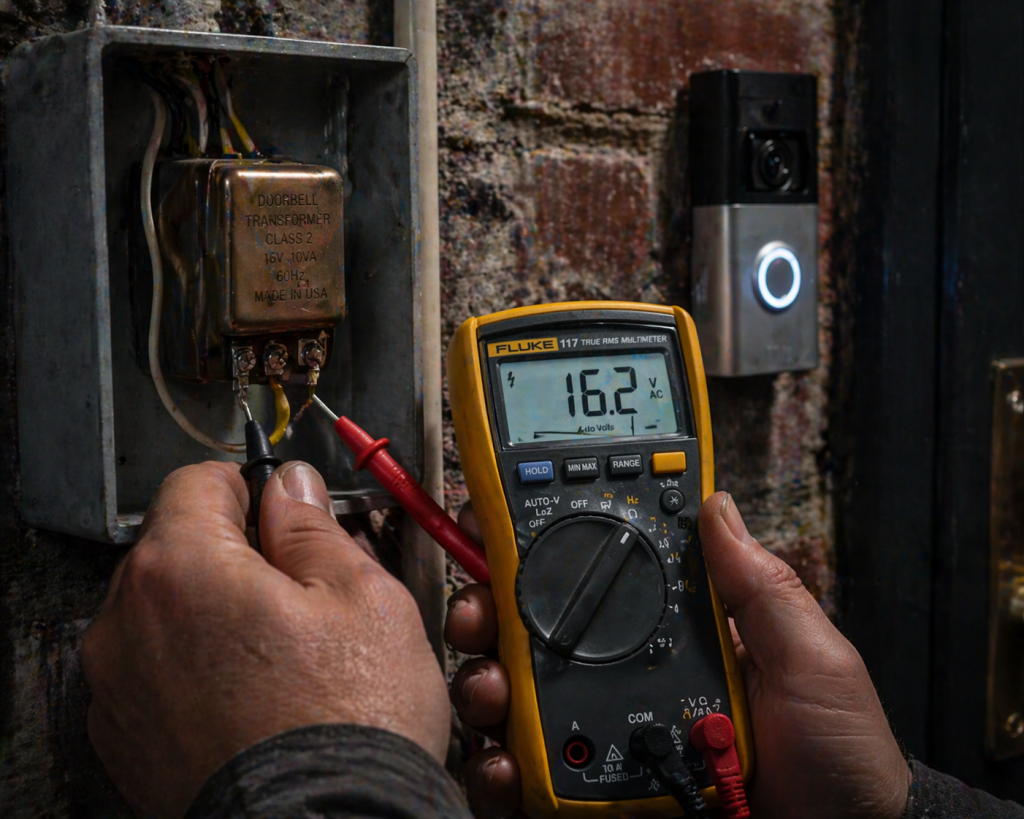
If the label shows 16V 10VA (the standard for old mechanical chimes), it will not reliably run a modern smart doorbell, period. No amount of Wi-Fi troubleshooting will fix it.
Why NYC Homes Run Into This Problem More Than Average
1. Age of the Housing Stock
NYC brownstones, pre-war co-ops, and mid-century rowhouses often have original or lightly-updated doorbell systems. The transformer might be 40, 60, even 80 years old. Some homes still have the original mechanical chime fed by a 10VA transformer that has been working (barely) since the Eisenhower administration. When you pair that with a home that may also have knob-and-tube wiring, the entire low-voltage system often needs a re-think, not just a swap.
2. Transformer Location Is Often Wrong for a Retrofit
In many NYC homes, the transformer is mounted directly on a junction box feeding the main panel — which is typically inside a closet, locked basement, or behind furniture. Accessing it to swap the unit requires opening up the junction box, which brings the whole job into licensed-electrician territory even if the smart doorbell itself is a plug-and-play replacement at the front door.
3. Co-op & Condo Buildings Add Another Layer
If you live in a co-op or condo, the doorbell transformer and the wiring running through common areas may be considered building infrastructure, not unit infrastructure. That means you cannot just replace it without board approval or building management sign-off, even in your own apartment.
4. Wired Intercom Systems
Many pre-war NYC apartments do not have a traditional doorbell at all — they have a building intercom system (Aiphone, TekTone, Lee Dan, or older 4-wire systems). These do not work with Ring/Nest/Arlo out of the box. Smart doorbells designed for single-family homes are not compatible with building intercoms without an adapter or, in many cases, a full intercom modernization.
Ring vs Nest vs Arlo: Power Requirements Compared
Each brand has its own voltage and VA floor. Here is the practical version, not the marketing one:
| Doorbell | Min Transformer | Preferred | Battery Option |
| Ring Video Doorbell Wired / Pro / Pro 2 | 16V AC, 10VA | 16–24V AC, 20VA+ | No (hardwired only) |
| Ring Video Doorbell (2nd / 3rd / 4th gen) | 8–24V AC, 10VA | 16V AC, 20VA+ | Yes (battery or wired) |
| Nest Doorbell (wired) | 16–24V AC, 10VA+ | 24V AC, 20VA+ | No (hardwired only) |
| Nest Doorbell (battery) | 16–24V AC optional | Wire for charging | Yes (primary power) |
| Arlo Video Doorbell (wired) | 16–24V AC, 10VA+ | 24V AC, 20VA+ | No (hardwired only) |
| Arlo Essential Wire-Free | None required | N/A | Yes (battery only) |
The ‘minimum’ column is what the manufacturer says the device will turn on with. The ‘preferred’ column is what the device actually needs to run reliably in a NYC home year-round, with cold winters and a chime that still works. Running at the minimum leads to intermittent failures, random disconnects, and the chime not firing.
How to Check Your Existing Transformer (Safely)
Before you buy a smart doorbell, check what you are working with. Here is the right sequence:
- Step 1 — Find the existing chime unit. Usually in a hallway or foyer, sometimes in the kitchen. Remove the cover. If it is an old mechanical chime with visible copper coils, that is a clue you’re working with older equipment.
- Step 2 — Find the transformer. Common locations in NYC homes: on or near the main electrical panel, in a basement utility area, in an attic, or on a junction box in a closet ceiling. Follow the thin bell wire from the chime backward.
- Step 3 — Read the label on the transformer. Look for voltage and VA rating. If you cannot read the label, or if you cannot find the transformer at all, stop here.
- Step 4 — Measure voltage at the button (with the old doorbell removed). Use a multimeter set to AC volts. The reading should match the transformer label, give or take a volt. If it reads wildly low (e.g., 4V when the transformer says 16V), there is wire damage or a connection problem in between.
- Step 5 — Decide: keep, upgrade, or replace. If the transformer is 16V 10VA or smaller, upgrading is the right move before installing any smart doorbell.
If any of that sounds uncertain, or the transformer is inaccessible, the low-voltage wiring runs through sealed walls in a co-op, or the voltage reading is off — that is the right time to stop and call a licensed electrician.
Replacing the Transformer: What It Actually Involves
A professional doorbell transformer replacement in NYC is a small but specific job. What the work typically includes:
- Locating the existing transformer (sometimes the longest part of the job in older NYC homes — they can be hidden behind finished surfaces).
- De-energizing the circuit feeding the transformer. This usually means shutting off one breaker in the main panel.
- Removing the old transformer from the junction box.
- Installing the new transformer — typically a 16V 30VA or 24V 40VA unit for smart doorbell compatibility.
- Verifying the existing bell wire is in good condition and sized correctly (18 AWG or heavier for most runs).
- Testing voltage at both the doorbell button and at the existing chime.
- Restoring power and verifying the old chime still rings (Ring and Nest both have a chime connector that passes power through to keep the mechanical chime functional).
For a full smart home rollout that goes beyond just the doorbell — cameras, smart switches, smart thermostats — we’ve covered the broader picture in our guide to wiring your NYC home for smart home gadgets, and the electrical setup for smart appliances if you’re coordinating multiple devices at once.
Common Installation Mistakes (And Why Things Stop Working)
- Using the existing 10VA transformer with a Ring Pro or Nest wired doorbell. The device powers on, rings once or twice, then starts dropping offline randomly. Classic symptom of an undersized transformer.
- Forgetting the chime connector. When a smart doorbell connects to a mechanical chime, most brands require a small capacitor (Ring calls it a Pro Power Kit, Nest a Chime Connector). Skip it and either the chime stops working or the device keeps rebooting.
- Connecting to a digital chime without verifying compatibility. Digital chimes draw power continuously, which many smart doorbells handle poorly. Check the compatibility list before installing.
- Using undersized bell wire over long runs. A 60-foot wire run in 20 AWG drops voltage significantly. If the front door is far from the transformer, the wire itself may be the bottleneck.
- Reversing the wires. Doorbell wiring is low-voltage AC, so it is not strictly polarity-sensitive — but the colored-wire conventions on smart doorbells do matter. Our green wire in electrical wiring guide covers the color-code basics; doorbell wiring is typically red/white with no ground, but always match the device’s terminal labels.
When to Call a Licensed NYC Electrician
Most Ring battery or Arlo wire-free installs are genuinely DIY — charge it, mount it, done. For everything else in a NYC home, the call-an-electrician threshold is lower than most homeowners realize:
- Your existing transformer is older than 2005, smaller than 20VA, or you cannot locate it.
- You live in a pre-war building with a building intercom rather than a standalone doorbell.
- You are in a co-op or condo and the transformer is in common area space.
- The existing bell wire runs through finished walls and a new run needs to be pulled.
- You plan to install multiple smart devices (doorbell + smart thermostat + smart smoke detectors) and want them on a single, properly-sized low-voltage system.
- The front door area shows signs of prior water intrusion, exposed wiring, or previous DIY work that looks improvised.
An electrical safety inspection before a smart home rollout is a low-cost way to verify what you are working with — especially important in older NYC homes where the low-voltage and line-voltage systems were installed decades apart.
Frequently Asked Questions
Can I install a Ring doorbell without a transformer?
Yes — the Ring Video Doorbell (2nd / 3rd / 4th gen) is battery-powered and does not require a transformer. You lose the connection to the existing mechanical chime, but the device works standalone. Ring’s wired models (Wired, Pro, Pro 2) all require a transformer.
Will my existing mechanical chime still work with a Nest or Ring smart doorbell?
Yes, if you install the chime connector / Pro Power Kit that comes with the device, and your transformer is sized correctly. Without the connector, the chime either stops working or causes the doorbell to reboot.
How much does it cost to replace a doorbell transformer in NYC?
A straightforward transformer swap, where the transformer is easily accessible and the existing wire is in good condition, typically runs $175–$350 in NYC with a licensed electrician. Jobs requiring new wire runs, panel work, or transformer relocation can go higher, and co-op work almost always does because of the building-approval overhead.
Is it legal to DIY a doorbell install in NYC?
Swapping a doorbell button at the front door is generally fine. Replacing the transformer — which involves opening a junction box connected to the main electrical system — is licensed electrical work in NYC. The DOB does not typically enforce this for a single transformer, but your homeowner’s insurance absolutely cares if something goes wrong.
My smart doorbell keeps going offline. Is that always a transformer issue?
Not always, but it is the most common cause in NYC homes. Other likely suspects: Wi-Fi signal weakness at the front door (masonry blocks a lot of signal), router placement, or damaged bell wire between the transformer and the device. A voltage reading at the doorbell button will tell you which category you’re in.
Bottom Line
Smart doorbells are sold as DIY products, and for new construction or homes built in the last 10 years, they usually are. For NYC housing stock — which skews older, denser, and more regulated than anywhere else in the country — the transformer question is the one that determines whether the install is 15 minutes or a half-day project with a licensed electrician.
Before you order a Ring, Nest, or Arlo, check the transformer. If it is 16V 10VA and older than your Netflix account, upgrade the transformer first. Everything downstream of that will work better, and the chime your family has heard for 30 years will keep ringing.
Need help with doorbell wiring, transformer replacement, or a broader smart home rollout in NYC? A&B Electric Wiring handles residential low-voltage work across Manhattan, Brooklyn, Queens, the Bronx, and Staten Island. Get in touch for a quote, or explore our full range of lighting and low-voltage installation services.