
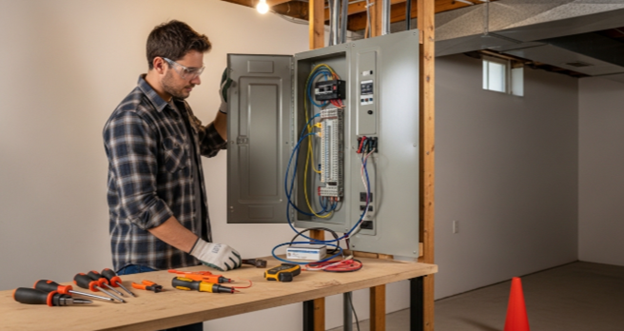
Replacing an electrical panel is one of the most complex and high-risk upgrades in a residential electrical system. It directly connects your home to the utility service, carries lethal voltage, and must meet strict National Electrical Code (NEC) and local inspection requirements. Beyond safety and legality, an outdated or faulty panel can contribute to a high electricity bill, making this question not just about DIY ability but also about efficiency, insurance, and long-term reliability.
This guide delivers a complete, electrician-level, code-aware explanation so you can make the right decision for your home, your budget, and your safety.
Short Answer — Can a Homeowner Replace Electrical Panel Safely & Legally?
In some areas, a homeowner is legally allowed to replace their own electrical panel if they:
- Pull the proper permits
- Follow local code requirements
- Pass inspection
However, legality does not mean it’s practical or safe.
Electrical panel replacement involves working on live service conductors, coordinating with the utility company, performing load calculations, installing grounding and bonding correctly, and torqueing connections to manufacturer specifications. These are tasks typically performed by a licensed electrician with specialized tools and training.
In real-world scenarios, most homeowners should not replace their own panel because:
- The incoming service wires remain energized even when the main breaker is off
- Mistakes can cause fire, equipment damage, or fatal shock
- Insurance and resale issues can arise if the work isn’t professionally documented
Why Electrical Panel Replacement Is a High-Risk Job
Live service lines and lethal voltage explained
The service entrance conductors feeding your panel are always live unless the utility disconnects power at the meter or pole. These wires carry enough current to cause instant electrocution.
Fire risk, arc fault, and improper torque issues
Loose lugs, incorrect breaker seating, or improper conductor sizing create heat. Heat leads to arcing, and arcing leads to electrical fires.
Utility company coordination and service disconnect requirements
Panel replacement often requires:
- Meter removal
- Temporary service disconnect
- Scheduled reconnect
This cannot be done independently in many jurisdictions.
Inspection, permits, and code compliance (NEC)
Every connection, grounding method, breaker type, and conductor size must meet NEC standards to pass inspection.
Legal & Code Requirements for Homeowners
Do local laws allow a homeowner to replace electrical panel?
Some jurisdictions allow owner-occupants to perform electrical work on their primary residence. Others require a licensed electrician for service equipment.
Permit requirements by jurisdiction
Panel replacement always requires a permit in compliant municipalities.
Inspection process and consequences of skipping it
Unpermitted work can result in:
- Fines
- Forced removal of the installation
- Failed home sale
Insurance liability and home resale complications
Insurance companies may deny claims if a fire is linked to unlicensed electrical work.
Can a homeowner replace electrical panel? — Skill Level & Experience Required
This is not comparable to replacing an outlet or light fixture.
You must understand:
- Residential load calculations
- Neutral/ground separation
- Bonding methods
- Service entrance sizing
- Breaker compatibility
You also need:
- Torque wrench for electrical lugs
- Multimeter and voltage testers
- PPE rated for arc flash protection
A master electrician trains for years to perform this work safely.
Signs Your Electrical Panel Needs Replacement
Breakers tripping frequently
Indicates overload or failing breakers.
Overheating or burning smell
A serious fire hazard.
Rust, corrosion, or water damage
Moisture destroys bus bars and connections.
60-amp or 100-amp panel in modern homes
Modern homes typically require 200 amps.
Fuse box vs breaker panel
Fuse boxes are outdated and often unsafe for today’s electrical loads.
How a Licensed Electrician Replaces an Electrical Panel
Pre-job load calculation & permit approval
Determines the correct panel size for the home.
Utility service shut-off coordination
Power is disconnected safely.
Labeling and documenting existing circuits
Ensures accurate reconnection.
Disconnecting feeders and service conductors
Performed using insulated tools and PPE.
Mounting and bonding the new panel
The enclosure is secured and bonded per code.
Breaker installation and circuit termination
Each circuit is properly landed and torqued.
Grounding electrode system connection
Critical for fault protection.
Torqueing to manufacturer specifications
Prevents overheating and arcing.
Inspection and power restoration
Final approval before the utility reconnects service.
Tools & Equipment Required for Electrical Panel Replacement
- Insulated hand tools
- Torque screwdriver or wrench
- Multimeter & voltage tester
- Approved cable lugs & connectors
- Arc-rated personal protective equipment (PPE)
DIY vs Hiring a Licensed Electrician
| Factor | DIY Panel Replacement | Licensed Electrician |
| Permit & inspection | Homeowner handles | Included & managed |
| Equipment cost | High upfront | Included in service |
| Code compliance | Risk of failure | Guaranteed |
| Safety risk | Extremely high | Professionally controlled |
| Insurance coverage | Often voided | Fully valid |
| Total cost reality | Savings unclear after tools & rework | Predictable and warranty-backed |
Risks of DIY Electrical Panel Replacement
Electrocution and arc flash hazards
The biggest and most immediate danger.
Failed inspection and forced rework
You may have to pay twice.
Voided homeowners insurance
A major financial risk.
Fire hazards from loose connections
Common in improperly torqued lugs.
Utility refusal to reconnect service
Power may not be restored until corrected.
When a Homeowner Can Work Inside the Electrical Panel
- Resetting a tripped breaker
- Replacing a breaker (where legally allowed)
- Installing a subpanel under permitted conditions
Not the service panel replacement itself.
DIY vs Pro — Who Should Replace the Electrical Panel?
Choose a licensed electrician if:
- The panel is the main service equipment
- A service upgrade is required
- The utility must disconnect power
DIY is only realistic for highly experienced individuals in jurisdictions that explicitly allow it.
How to Hire the Right Licensed Electrician
License, insurance, and permit handling
Always verify credentials.
Panel brand selection (Square D, Siemens, Eaton, etc.)
Quality matters for long-term reliability.
Warranty and inspection guarantees
Look for written assurance.
Questions to ask before hiring
- Is permit included?
- Will you coordinate with the utility?
- What amperage upgrade do I need?
Electrical Panel Upgrade Options for Modern Homes
- 100-amp → 200-amp upgrade
- Smart electrical panels with energy monitoring
- Generator-ready panels
- EV-ready capacity for future charging
Safety Considerations
- NEC compliance
- Arc-fault & GFCI protection
- Proper grounding & bonding
- Whole-home surge protection
These directly impact fire prevention and life safety.
FAQs — can a homeowner replace electrical panel?
Do you need a permit to replace an electrical panel?
Yes, in almost every jurisdiction.
Can you replace an electrical panel without turning off power?
No. The service must be disconnected.
How long does panel replacement take?
Typically 6–10 hours for a standard upgrade.
What happens if you fail an electrical inspection?
The system must be corrected and reinspected.
Is upgrading to 200 amps worth it?
Yes, for modern appliances, EV chargers, and future capacity.
Will homeowners insurance cover DIY electrical work?
Often not if the work is unlicensed or unpermitted.
Can I replace a fuse box with a breaker panel myself?
Only where explicitly allowed and with permits — but rarely recommended.
Does the utility company have to disconnect power?
Yes, for safe service panel replacement.
Conclusion — Should a Homeowner Replace Their Own Electrical Panel?
Technically, can a homeowner replace electrical panel? In some areas, yes. Realistically and safely, it’s a professional-level job that should almost always be done by a licensed electrician, like the experts at AB Electric Wiring, to ensure code compliance and long-term safety.
This upgrade connects directly to your home’s power source, affects fire safety, insurance validity, code compliance, and property value. One mistake can cost far more than the price of professional installation.
If your goal is long-term safety, inspection approval, and a future-proof electrical system, hiring a qualified electrician is not an expense it’s protection for your home and everyone in it.