
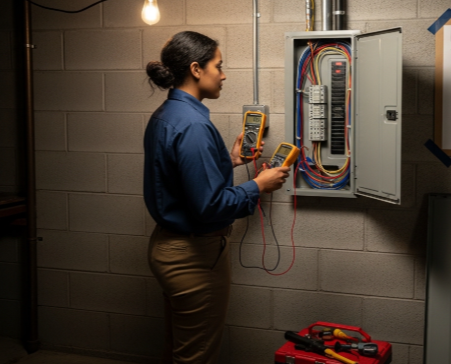
Replacing an electrical panel is one of the most important upgrades you can make for safety, capacity, and code compliance. But the first question every homeowner asks is simple: how long will the power be out and how long will the job actually take?
This expert, electrician-informed guide gives you real-world timelines, step-by-step workflow, and the factors that separate a smooth same-day upgrade from a multi-day project.
Short Answer — How Long Does It Take to Replace an Electrical Panel?
In most homes, replacing an electrical panel takes 4 to 8 hours, and power is typically restored the same day.
Typical timelines:
- Like-for-like panel swap: 4–6 hours
- 100A → 200A service upgrade: 6–10 hours
- Panel relocation or major rewiring: 1–2 days
When it becomes a 2-day job:
- Utility scheduling delays
- Failed inspection
- Old wiring that must be extended or replaced
- Meter base or service mast upgrades
Real electrician timeline (arrival → lights back on):
- Site prep & shutdown → 30–60 minutes
- Panel removal → 1 hour
- New panel installation → 2–3 hours
- Circuit termination & balancing → 2–3 hours
- Inspection & re-energizing → 30–90 minutes
Why Homeowners Need Electrical Panel Replacement in the First Place
Electrical panels don’t last forever, and at AB Electric Wiring most replacements are triggered by real safety hazards or increasing power capacity demands.
Aging panels (25–40+ years)
Older panels struggle with modern electrical demand and often lack required safety protection.
Insufficient amperage
Homes built decades ago were never designed for:
- EV chargers
- HVAC systems
- Modern kitchens
- Home offices
Insurance and code issues
Many insurers require replacement of obsolete panels like Federal Pacific or Zinsco.
Warning signs electricians see on service calls:
- Burn marks or melted insulation
- Buzzing breakers
- Constant tripping
- Overheating panel face
A suburban home upgrading to central air found their 100A panel running at 140% load a same-day 200A upgrade solved the issue.
Key Factors That Affect How Long It Takes to Replace an Electrical Panel
Panel Type and Amperage Upgrade Complexity
A like-for-like swap is fast.
A 100A → 200A upgrade may require:
- New service entrance cable
- Meter socket upgrade
- Grounding system update
Condition of Existing Wiring
Delays occur when electricians find:
- Aluminum branch circuits
- Short conductors that must be extended
- Double-tapped neutrals that must be corrected
Permit, Inspection & Utility Coordination
In many areas, the utility controls the disconnect and reconnect window — not the electrician.
Mounting Location & Accessibility
- Unfinished basement → fastest
- Finished wall → drywall cutting and repair
- Outdoor meter combo → weather-dependent
Grounding & Bonding Corrections
Modern code often requires:
- Ground rods
- Water pipe bonding
- Inter-system bonding
Code Upgrades Required in 2026 NEC
Adding AFCI and GFCI breakers increases installation time but improves safety.
How Long Does It Take to Replace an Electrical Panel in Old vs New Homes?
- Newer home → same-day completion
- Older home with cloth or knob-and-tube wiring → 1–2 days
Electrician’s Step-by-Step Workflow for Panel Replacement
Load Calculation & Job Planning
Determines correct panel size and breaker layout.
Permit Pulling & Utility Shut-Off Scheduling
Ensures legal compliance and timed disconnect.
Power Shutdown & Safety Lockout
Full safety isolation before work begins.
Removing the Existing Panel
All circuits are labeled before removal.
Installing the New Panel & Meter Base (If Required)
Mounted, leveled, and secured.
Re-Terminating Circuits One by One
This is the most time-intensive phase.
Grounding, Bonding & Surge Protection
Critical for code and safety.
Breaker Labeling & Load Balancing
Prevents overloads and future troubleshooting issues.
Inspection & Power Restoration
Final approval before re-energizing.
How Long Does It Take to Replace an Electrical Panel Step by Step? (Time per phase)
| Phase | Time |
| Planning & shutdown | 1 hour |
| Removal | 1 hour |
| Panel installation | 2–3 hours |
| Circuit termination | 2–3 hours |
| Inspection & reconnection | 1 hour |
Real Job Timelines From the Field (Electrician Case Studies)
Standard 200A upgrade: 8 hours, same-day power restoration
Federal Pacific emergency replacement: 6 hours due to safety risk
Panel relocation with service mast replacement: 2 days
Like-for-like swap in unfinished basement: 4.5 hours total
Electrical Panel Replacement Time by Project Type
| Project Type | Typical Time | Power Downtime | Complexity | Notes |
| Like-for-like panel swap | 4–6 hrs | 4–6 hrs | Low | Fastest scenario |
| 100A → 200A upgrade | 6–10 hrs | 6–8 hrs | Medium | Most common upgrade |
| Panel relocation | 1–2 days | 8–16 hrs | High | Requires rewiring |
| Meter + service upgrade | 1–2 days | 8–12 hrs | High | Utility coordination |
| Old home rewiring integration | 2+ days | 8–20 hrs | Very High | Wiring corrections |
Power Outage Duration — How Long Will Your Home Be Without Electricity?
Same-day reconnection
Most homes: 4–8 hours without power
Utility delays
Can extend outage to the next day.
Temporary power options
Electricians sometimes provide:
- Generator tie-ins
- Temporary circuits for essentials
Cost vs Time — Does Faster Panel Replacement Mean Higher Cost?
Yes, speed often depends on labor resources.
- Larger crew = shorter outage
- Pre-built breaker layout = faster install
- Emergency replacement = premium pricing
Safety & Code Compliance Considerations
This is never a DIY job because:
- Live service conductors remain energized
- Arc flash risk is extreme
- Inspection is mandatory
Modern panels must include:
- AFCI protection
- GFCI protection
- Proper grounding system
Delaying replacement when a panel is failing increases fire risk.
How to Prepare Your Home Before Electricians Arrive
- Clear a 3–4 ft working space
- Shut down sensitive electronics
- Plan for 6–8 hours without power
- Provide clear access to the panel
Preparation alone can save 1–2 hours of labor time.
Common Delays That Extend Panel Replacement Time
- Hidden wall damage
- Failed inspection
- Utility rescheduling
- Incorrect panel size delivered
- Exterior service upgrades in bad weather
Signs Your Electrical Panel Replacement Will Take Longer Than Normal
- Flickering under load
- Overcrowded breakers
- Rust inside the enclosure
- Cloth or knob-and-tube wiring
These indicate deeper electrical system issues.
Pro Tips From a Licensed Electrician to Reduce Installation Time
- Perform load calculation in advance
- Schedule early morning disconnect
- Choose a high-quality, readily available panel brand
- Plan the breaker layout before shutdown
FAQs — How Long Does It Take to Replace an Electrical Panel?
Can an electrical panel be replaced in one day?
Yes. Most residential replacements are completed in a single day.
How long does it take to replace an electrical panel and restore power?
Typically 4–8 hours from shutdown to full restoration.
Do I need to leave my home during the replacement?
No, but you will be without power.
How long does it take to replace an electrical panel in an emergency?
Emergency swaps can be completed in 4–6 hours.
What delays the inspection process?
Inspector availability and code corrections.
Is upgrading to 200 amps more time-consuming?
Yes it usually adds 2–4 hours.
Can electricians work without shutting off power?
Not for a full panel replacement.
How far in advance should I schedule a panel replacement?
1–3 weeks in most areas due to permits and utility coordination.
Conclusion — Realistic Timeframes Homeowners Should Expect
In real-world conditions, most electrical panel replacements are completed in one day, with 4–8 hours of power downtime. Complex upgrades, older homes, or service relocations can extend the project to multiple days.
The biggest time-saving factor isn’t the panel, it’s the experience of the electrician planning the job correctly. Proper load calculations, coordinated permits, and pre-built layouts turn what could be a stressful outage into a smooth, same-day upgrade.
If you plan ahead, hire a qualified professional, and prepare your home for the installation, you can expect a fast, code-compliant panel replacement with minimal disruption and decades of improved electrical safety and capacity.