
In short: Yes, you can mix wire gauges, but only if you follow specific safety rules. While it is technically possible to have different wire sizes on the same circuit, the safety of that circuit is determined by the thinnest wire used. If you don’t follow the proper guidelines, you risk creating a major fire hazard.
The Golden Rule of Wire Gauges
In electrical work, wire gauge (thickness) is measured by the American Wire Gauge (AWG) system. The smaller the number, the thicker the wire. For example, 12-gauge wire is thicker than 14-gauge wire.
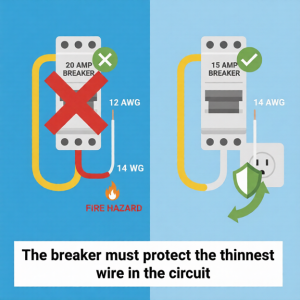
The most important rule when mixing gauges is: The circuit breaker must be sized to protect the thinnest wire in the circuit.
- 14-Gauge Wire: Rated for a maximum of 15 Amps.
- 12-Gauge Wire: Rated for a maximum of 20 Amps.
If you have a circuit that uses mostly 12-gauge wire but you add a small section of 14-gauge wire, you must use a 15-amp breaker. If you use a 20-amp breaker, the 14-gauge wire could overheat and catch fire before the breaker ever trips.
When Is It Okay to Mix Gauges?
There is one scenario where mixing gauges is perfectly safe and common: using a thicker wire than required.
You can always use a thicker wire (like 12-gauge) on a circuit protected by a smaller breaker (like 15-amp). For example, if you are running a long wire to a distant shed, an electrician might use 10-gauge or 12-gauge wire to prevent “voltage drop,” even if the circuit only needs 15 amps.
Why Mixing Gauges Is Usually Discouraged
Even though it can be done safely by down-sizing the breaker, most professional electricians avoid mixing wire gauges in a single circuit for several reasons:
- Future Confusion: A future homeowner or electrician might see 12-gauge wire at the panel and assume it is a 20-amp circuit. If they replace the 15-amp breaker with a 20-amp breaker, they unknowingly create a fire hazard where the 14-gauge wire exists.
- Code Inspections: Some local building inspectors dislike seeing mixed gauges because it makes the system harder to verify and can lead to red flags during a home sale.
- Inconsistency: It is much easier to maintain and troubleshoot a home when all wires on a circuit are uniform.
Dangerous Mistakes to Avoid
- Never use a 20-amp breaker on 14-gauge wire: This is a violation of the National Electrical Code (NEC) and is a leading cause of electrical fires.
- Don’t ignore the pigtails: If you are connecting a new outlet using short pieces of wire (pigtails), ensure those pigtails are at least the same gauge as the rest of the circuit.
- Watch out for extension cords: While not part of the permanent wiring, using a thin extension cord for high-draw appliances like space heaters is essentially mixing gauges and often leads to melted cords.
Conclusion
While you can technically mix wire gauges, you should only do so if the circuit breaker is rated for the smallest wire in the entire loop. For the sake of safety and future-proofing your home, it is always best to stick to one wire size per circuit. If you are unsure about the gauge of the wires in your walls, contact a licensed electrician to inspect your system and ensure your breakers are sized correctly.