
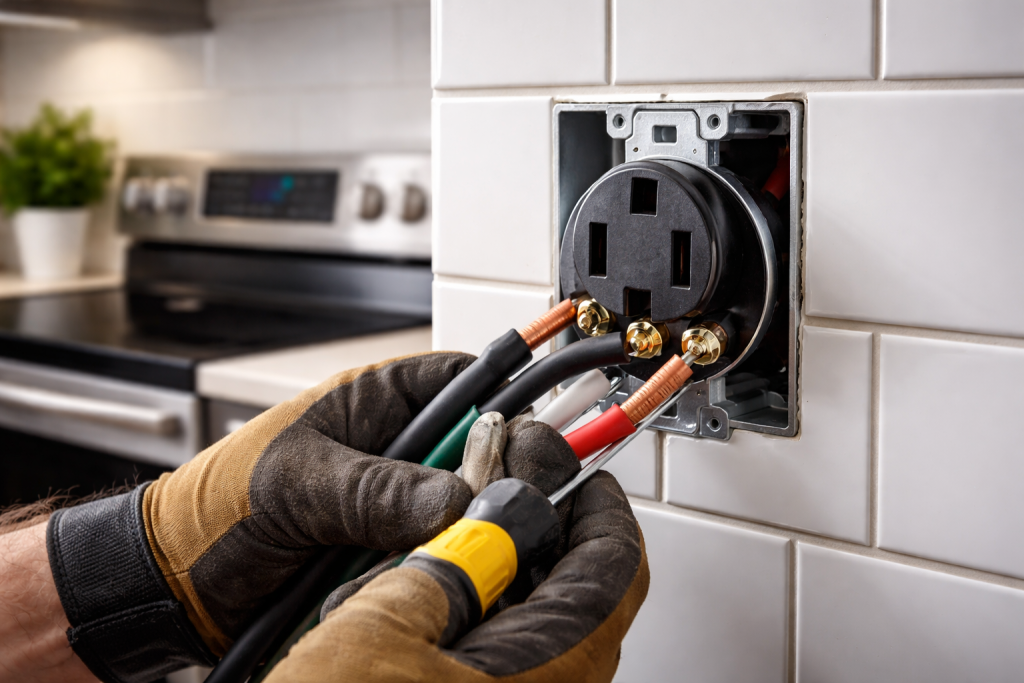
A standard wall outlet delivers 120 volts. That is enough to run a lamp, a phone charger, or a kitchen mixer. It is not enough to run an electric dryer, a range, or a wall oven. Those appliances draw far more power than a standard circuit can deliver, and they require a dedicated 240-volt circuit with the correct outlet, the right gauge wire, and a properly sized double-pole breaker. When homeowners move into a new space, switch from gas to electric appliances, or replace older equipment that had different plug configurations, understanding what is actually involved in 240V outlet installation helps avoid mistakes that range from nuisance tripping all the way to fire.
How a 240V Circuit Works
A standard 120-volt circuit uses one hot wire, one neutral wire, and a ground wire. A 240-volt circuit uses two hot wires, a neutral, and a ground. Each hot wire carries 120 volts, and together they deliver 240 volts to the appliance. Because the circuit draws from both sides of the electrical panel simultaneously, it requires a double-pole breaker that occupies two slots in the panel rather than one.
This configuration is why 240-volt outlets look different from standard ones. They are physically larger, have more prong slots, and cannot be confused with standard outlets by design. The specific configuration varies by appliance type and amperage rating, which is where the NEMA designations come in.
Dryers: 30-Amp Circuit and the 3-Prong vs 4-Prong Issue
Electric dryers in the United States run on a dedicated 240-volt, 30-amp circuit. The standard outlet for this circuit is a NEMA 14-30R, which accommodates a four-prong plug. The circuit uses 10-gauge copper wire and is protected by a 30-amp double-pole breaker.
Homes built before 1996 were typically wired with a three-prong dryer outlet, the NEMA 10-30. This older configuration used only three conductors: two hot wires and a neutral, with the appliance frame bonded to the neutral to serve as a grounding path. The National Electrical Code changed this requirement after 1996, mandating the four-prong configuration that separates the neutral and ground conductors. The newer setup is meaningfully safer because it eliminates the scenario where a neutral fault can energize the appliance frame.
In older homes that still have three-prong dryer outlets, the existing outlet is permitted to remain for a dryer replacement as long as the circuit was installed to code when it was built. However, upgrading to a four-prong outlet is strongly recommended whenever any work is being done on that circuit. If the existing wiring contains only three conductors, a new four-wire run is required to make the upgrade, which is a job for a licensed electrician and requires a permit in most jurisdictions including New York City.
Ranges and Wall Ovens: 50-Amp Circuit and Higher Demands
Electric ranges and wall ovens draw significantly more power than dryers. Most full-size ranges require a dedicated 240-volt, 50-amp circuit with a NEMA 14-50R outlet. The circuit uses 6-gauge copper wire and a 50-amp double-pole breaker. Some larger or commercial-style ranges specify even higher amperage, so checking the manufacturer’s specifications before planning the electrical work matters.
Unlike dryers, ranges also need the neutral conductor because the control electronics, clock, and lighting inside the appliance operate on 120 volts while the heating elements run on 240. This is why a range circuit uses four conductors rather than the three-conductor configuration that pure 240-volt loads sometimes use.
If the range will be replacing a gas appliance in a kitchen that was never wired for electric cooking, running the circuit is a more substantial project. A new 50-amp circuit requires running 6-gauge cable from the panel all the way to the appliance location, which often means routing through walls, across a basement ceiling, or through conduit. The distance of that run matters: longer wire runs increase resistance and can result in voltage drop that affects appliance performance. An electrician doing this work calculates the run length as part of determining the correct wire gauge. The relationship between wire gauge and circuit capacity is something the guide on mixing wire gauges in one circuit explains in useful detail for homeowners trying to understand why this calculation cannot be shortcut.
Why a Dedicated Circuit Is Required
Both dryers and ranges must be on their own dedicated circuits that serve no other loads. Sharing a 240-volt circuit between a dryer and any other appliance creates the risk of overloading the circuit and tripping the breaker, and it is a code violation regardless of whether overloading actually occurs in practice.
This dedicated circuit requirement is also why panel capacity has to be evaluated before a 240-volt outlet is added. A panel that is already carrying a full load of existing circuits may not have available slots or adequate remaining ampacity to support a new 30-amp or 50-amp double-pole breaker. If the panel is full or at capacity, the 240-volt outlet project cannot be completed without addressing the panel first. The full picture of what a panel upgrade involves and what it costs is relevant for homeowners in this situation, particularly those switching from gas to electric appliances who may be adding multiple high-draw circuits at once. That transition is covered in detail in the guide on switching from gas to induction cooking.
Reusing Existing Wiring and What Gets Checked
When a homeowner is replacing an existing electric dryer or range with a new one of the same type, the question of whether existing wiring can be reused is common. The answer depends on several things an electrician checks before signing off on the installation.
The wire gauge has to match the circuit’s amperage rating. A 30-amp dryer circuit requires 10-gauge wire minimum. A 50 amp range circuit requires 6-gauge wire minimum. If existing wiring is undersized for the breaker protecting it, the combination is a code violation and a potential fire hazard regardless of whether anything has gone wrong yet.
The condition of the wiring matters. Older wiring with deteriorated insulation, connections made with aluminum rather than copper conductors, or fabric-wrapped insulation from pre-1960s construction all require evaluation before assuming existing wiring is safe to reuse. These are among the top electrical problems found in older homes and come up regularly when electricians open up outlet boxes during appliance circuit work.
The outlet configuration has to match the appliance plug. Installing a NEMA 14-30 outlet where a NEMA 14-50 is needed, or vice versa, means the appliance physically cannot be plugged in. Adapters that force a mismatch between outlet and plug configurations should never be used for high amperage appliances.
The NEMA 14-50 and Its Other Uses
The NEMA 14-50 outlet specified for ranges has become the standard outlet for home EV charger installations as well, which is relevant for homeowners planning both at the same time or thinking ahead about future electrical needs. The full scope of what EV charger installation involves is similar in its electrical requirements to a range circuit, and homeowners who know they will add EV charging can sometimes consolidate the planning and permitting for both.
Permits and Who Does the Work
Installing a new 240-volt circuit in New York City requires a permit filed by a NYC Licensed Master Electrician through DOB NOW. This applies whether the circuit is for a dryer, a range, or any other 240-volt appliance. The NYC electrical permit process covers how that filing and inspection sequence works. In buildings where the service capacity is also being evaluated, the Con Edison service upgrade process may also be part of the picture.
The cost of hiring a licensed electrician for a 240-volt outlet installation varies based on whether an existing circuit is being upgraded or a new run is being pulled from the panel. Either way, it is work that directly affects the safety of high-draw appliances used daily in the home, and getting the wire gauge, breaker size, outlet type, and grounding configuration right from the start is the only version of this project worth doing.