
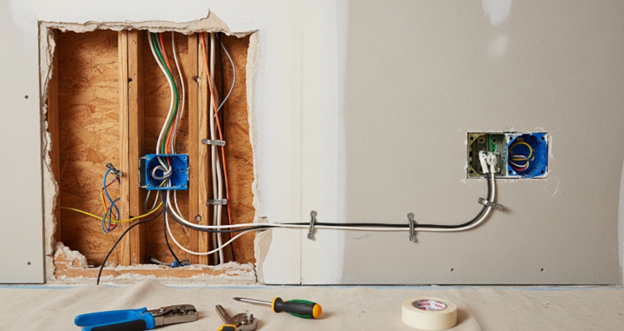
Rewiring a home sounds messy, expensive, and disruptive. Most homeowners immediately picture torn-out drywall, exposed studs, dust everywhere, and weeks of repairs. Naturally, the first question is: can you rewire a house without removing drywall?
The good news is in many cases, yes! you can. But it depends heavily on your home’s structure, access points, and existing wiring conditions.
This guide gives you the most complete, real-world answer possible including electrician insights, cost breakdowns, techniques used in the field, and when drywall removal is unavoidable.
Short Answer
Yes, you can rewire a house without removing drywall. Licensed electricians often use “wire fishing” techniques to route new cables behind finished walls with minimal cutting. However, full rewiring in older homes especially those with insulation barriers or tight framing may require limited wall openings.
The feasibility depends on attic access, basement access, wall construction, and code requirements.
What Does It Mean to Rewire a House?
Rewiring means replacing outdated, unsafe, or undersized electrical wiring with modern, code-compliant wiring. It is not the same as simply upgrading a panel.
Understanding Full vs Partial Rewiring
- Full home rewire: All branch circuits replaced.
- Partial circuit replacement: Only problematic or overloaded circuits upgraded.
- Panel upgrade vs wiring replacement: A new panel does not mean new wiring.
- Replacing knob-and-tube vs modern Romex: Older systems lack grounding and insulation protection.
Rewiring modernizes safety, increases load capacity, and brings the home up to current electrical code standards.
Why Homes Need Rewiring
Rewiring is often driven by safety or functionality concerns:
- Outdated knob-and-tube wiring
- Aluminum branch wiring issues
- Frequent breaker trips
- Burning smells or flickering lights
- Renovations requiring higher electrical demand
In homes built before the 1980s, wiring may not support today’s appliances, EV chargers, HVAC systems, and smart technology.
Can You Rewire a House Without Removing Drywall?
This is where structure matters more than anything.
When It’s Possible
Rewiring without removing drywall is typically feasible when:
- There is accessible attic space for top-down wiring
- There is basement or crawl space access for bottom-up wiring
- Interior walls are non-insulated
- Framing allows cable passage
- There is no heavy fire blocking
In these cases, electricians drill through top or bottom plates and fish wires vertically.
When It’s Difficult or Impossible
Some homes make drywall-free rewiring extremely challenging:
- Spray foam insulation blocking wall cavities
- Brick or masonry construction
- Horizontal fire blocking between studs
- Tight multi-story framing without access
In such cases, controlled drywall removal becomes necessary for safety and compliance.
Professional Techniques Electricians Use
To avoid large wall damage, professionals rely on:
- Fish tape and flexible drill bits
- Using existing conduit paths
- Cutting small strategic access holes
- Dropping wires through attic cavities
- Installing old-work electrical boxes
The goal is minimal intrusion while maintaining full code compliance.
Real Electrician Case Study (From the Field)
A Real Scenario: 1970s Two-Story Home Rewired Without Removing Drywall
A suburban homeowner faced constant breaker trips. The issue: aluminum branch wiring throughout the house. The home had recently been painted, and the homeowner was strongly against tearing open walls.
The Plan
- Attic access used for second-floor drops
- Basement access used for first-floor circuits
- Only 3 small access holes per wall cavity
- Old-work boxes installed at outlets
The Result
- 90% of drywall preserved
- New grounded copper wiring installed
- 200-amp panel upgrade completed
- Passed final inspection
Electrician’s Insight:
“When we have attic and basement access, we almost never need to remove full drywall sheets. Strategic fishing dramatically reduces repair costs.”
This real-world example shows how planning and experience determine success.
How to Rewire a House Without Removing Drywall
Step 1: Inspection & Load Assessment
- Identify existing wiring type
- Evaluate panel capacity
- Check for overheating risks
- Assess grounding system
A proper load calculation ensures circuits are designed correctly.
Step 2: Mapping the Circuit Plan
- Label each room
- Identify high-load appliances
- Separate lighting and outlet circuits
- Plan dedicated circuits where required
This blueprint prevents future overloads.
Step 3: Access Point Strategy
- Use attic for top-down runs
- Use basement for bottom-up runs
- Identify minimal wall cut zones
Smart planning minimizes wall damage.
Step 4: Fishing New Wires
- Drill through top plates
- Insert fish tape
- Pull NM cable carefully
- Secure cables per NEC requirements
Precision matters to avoid insulation damage.
Step 5: Replacing Electrical Boxes
- Install old-work retrofit boxes
- Upgrade outlets to grounded receptacles
- Add AFCI protection where required
This ensures modern safety compliance.
Step 6: Panel Connections & Testing
- Connect circuits to breakers
- Verify grounding and bonding
- Conduct voltage testing
- Schedule final inspection
Testing ensures everything operates safely.
Rewiring With vs Without Drywall Removal
| Factor | Without Removing Drywall | With Drywall Removal |
| Cost | Moderate | Higher (includes repairs) |
| Time | Faster | Longer |
| Wall Damage | Minimal | Significant |
| Accessibility | Limited by structure | Full access |
| Ideal For | Homes with attic/basement access | Major renovations |
| Aesthetic Impact | Low | High repair required |
Costs Involved in Rewiring Without Removing Drywall
What Impacts Price?
- Home size (square footage)
- Number of stories
- Panel upgrade needs
- Labor complexity
- Local permit requirements
Typical U.S. Cost Range
- Partial rewire: $3,000–$8,000
- Full rewire: $8,000–$20,000+
Homes with difficult access may trend higher. (not official prices from AB ELECTRIC WIRING).
Risks & Safety Considerations
Electrical Code Compliance
Modern rewiring must meet National Electrical Code standards, including:
- Proper grounding
- AFCI protection
- Circuit load balancing
Fire Safety
- Avoid improper splicing
- Prevent overloaded circuits
- Replace unsafe aluminum connections
Permits & Inspections
Permits are typically mandatory for full rewires. Licensed electricians ensure inspections pass and insurance coverage remains valid.
Sub-Questions People Also Ask
- Can you rewire a house through the attic?
- Can electricians run wire behind finished walls?
- How much drywall needs to be removed for rewiring?
- Can you rewire a house from the basement?
- Is rewiring worth it in an old house?
- How long does a full house rewire take?
- Does homeowners insurance require rewiring old wiring?
- Can you upgrade outlets without replacing all wiring?
Pros and Cons of Rewiring Without Removing Drywall
Pros
- Less mess
- Lower repair costs
- Faster completion
- Preserves home aesthetics
Cons
- Not always feasible
- Outlet relocation may be limited
- Structural obstacles can slow progress
Signs You Should NOT Avoid Drywall Removal
- Major remodeling underway
- Mold or water damage present
- Structural framing issues
- Walls already open
In these situations, full access may be smarter and safer.
FAQs
1. Can you rewire a house without removing drywall in a two-story home?
Yes, if attic and basement access allow vertical wire runs.
2. How do electricians run wires through finished walls?
Using fish tape, flexible drill bits, and small strategic access openings.
3. Will rewiring damage my walls?
Minimal damage occurs when performed by experienced professionals.
4. How long does rewiring take without drywall removal?
Typically 3–10 days depending on size and complexity.
5. Is it cheaper to rewire without removing drywall?
Yes, because drywall repair costs are significantly reduced.
6. Do I need to move out during rewiring?
Usually not, though temporary power interruptions occur.
7. Can knob-and-tube wiring be replaced without wall removal?
Often yes, but accessibility and insulation determine feasibility.
8. Does insurance cover rewiring costs?
Generally no, unless damage is tied to a covered event.
Final Verdict: Should You Rewire Without Removing Drywall?
So, can you rewire a house without removing drywall? In many homes absolutely yes.
When attic and basement access exist, skilled electricians can strategically fish new wiring with minimal wall disruption. However, construction style, insulation, and safety requirements ultimately determine feasibility.
From a professional perspective, preserving drywall is ideal but never at the expense of electrical safety or code compliance.
If your home shows warning signs like frequent breaker trips, aluminum wiring, or outdated systems, schedule a licensed inspection. An assessment will determine whether a drywall-free rewire is realistic for your specific home.
Safety first. Cosmetics second. Always.