
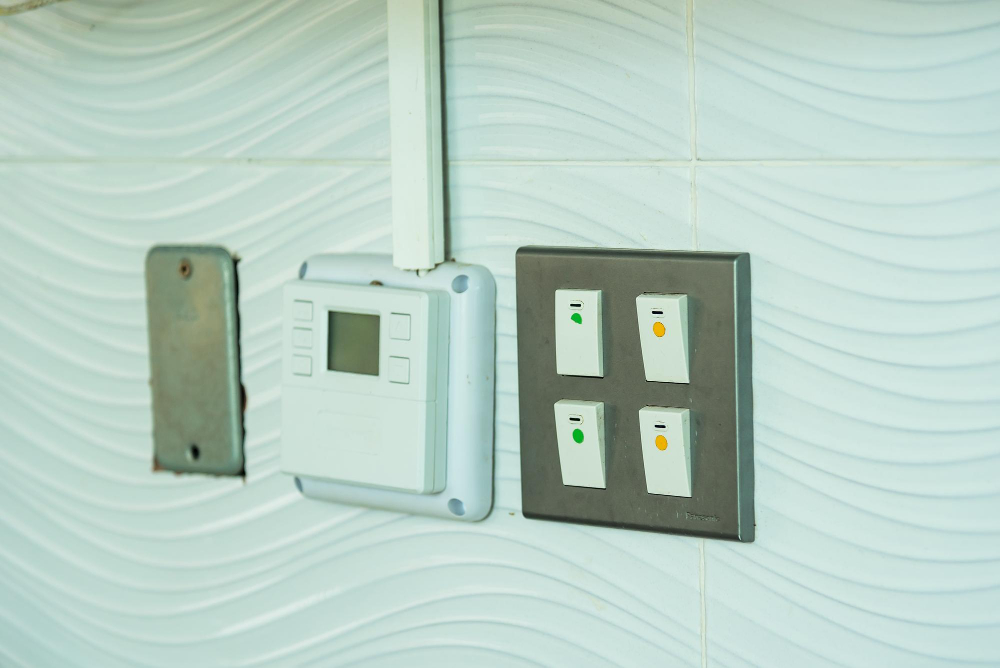
A three-way switch is one of those things in residential electrical work that sounds straightforward until it stops working. The concept is simple controlling one light from two different locations but the wiring behind it is fundamentally different from a standard switch, and the failure modes are specific enough that they can be genuinely confusing to diagnose without understanding how the circuit works in the first place. Staircases, long hallways, large open-plan rooms, and garage entry points are the most common places homeowners encounter three-way switches, and they are also where complaints about lights that only work from one end, or refuse to turn off from one location, consistently show up.
What Makes a Three-Way Switch Different
A standard single-pole switch has two terminals. Power comes in on one side, goes out the other when the switch is on, and stops when it is off. Simple. A three-way switch has three terminals: one called the common terminal, which is usually identified by a darker screw color, and two called traveler terminals, which are typically brass-colored screws. The three-way switch does not simply open and close a circuit. It redirects current from one path to another depending on which position the toggle is in.
The two switches at either end of a three-way system are connected by two wires called traveler wires. These run from the traveler terminals of the first switch to the traveler terminals of the second switch. At the hot end of the circuit, the incoming power wire connects to the common terminal of the first switch. At the other end, the common terminal of the second switch connects to the light fixture. When both switches are positioned so that a continuous path exists through the traveler wires from one common to the other, the light is on. When the positions create a break in that path, the light is off. Either switch can create or break the path independently of the other, which is what allows control from two locations.
The cable running between the two switches carries three conductors: two travelers and a ground. This is where the guide on 2-wire vs 3-wire wiring configurations becomes directly relevant, because the cable type is not optional in a three-way installation and substituting a two-wire cable is a wiring error that makes the circuit impossible to complete correctly.
When Three Locations Are Needed: The Four-Way Switch
A three-way system handles exactly two control locations. If a room has three light switches for the same fixture a large open floor plan, a room with three doorways, or a basement with switches at the top and bottom of each staircase a four-way switch is installed between the two three-way switches. A four-way switch has four terminals and works by exchanging which traveler wire connects to which path. Multiple four-way switches can be chained in sequence, each one adding an additional control location while the two three-way switches always remain at the ends of the system.
How Three-Way Switches Fail
Three-way switch failures follow a small number of predictable patterns, and each pattern produces a recognizable symptom.
The most common failure is a wiring error made during a switch replacement. When someone replaces a three-way switch without first noting which wire was connected to the common terminal, they frequently land the common wire on a traveler terminal or vice versa. The symptom is consistent: one switch location controls the light normally while the other either does nothing at all or only functions when the first switch is in a specific position. The light is not actually broken, and the breaker has not tripped. The logic of the circuit is simply broken because the wiring at one switch does not match what the circuit requires.
A related error occurs when someone replaces a three-way switch with a standard single-pole switch. Single-pole switches only have two active terminals, so one of the traveler wires gets left disconnected. The result is a switch that works in one position only when the disconnected traveler happens to be the path power is using and does nothing in the other position. This is a common discovery in homes where past owners did their own electrical work without fully understanding what they were working on, and it appears regularly alongside the other warning signs of unlicensed electrical work.
Loose wire connections produce a different symptom pattern. Rather than the all-or-nothing behavior of a miswired switch, a loose connection causes intermittent behavior the light works sometimes, flickers when the switch is touched or the wall is bumped, or fails unpredictably. The loose wire may be at the switch terminal itself, at a wire nut connection inside the box, or anywhere along the circuit. This type of failure can produce arcing at the connection point, which generates heat and creates a fire risk even if the light continues to function most of the time. A switch plate or box that feels warm to the touch is the physical signal that arcing may be occurring, and understanding what a warm switch plate means in terms of risk helps homeowners recognize when the symptom is more serious than a simple wiring nuisance.
Switch failure from worn mechanical contacts is less common than wiring errors but does happen in older installations where the switch has been toggled thousands of times over decades. A switch with burned or worn contacts may lose continuity in one position, meaning the light can be turned on from one switch location but not off from the other, or the light will not respond to one switch at all regardless of the other switch’s position. Testing for this requires a continuity tester or multimeter applied to the switch terminals. When one three-way switch in a pair has failed, replacing both switches simultaneously is the standard recommendation, since both are the same age and a failing switch is often followed by its partner failing shortly after.
Three-Way Switches and Dimmer Compatibility
Dimmer switches in three-way configurations have additional requirements beyond what standard dimmer installations involve. A three-way dimmer switch must be specifically rated for three-way use. In most installations, the dimmer occupies one switch location and a compatible three-way accessory switch not a standard toggle occupies the other. Installing a standard single-pole dimmer in a three-way circuit, or pairing a three-way dimmer with an incompatible accessory switch, produces exactly the flickering, buzzing, and erratic behavior that is covered in detail in the piece on dimmer switch compatibility and LED flickering.
Smart switches in three-way configurations introduce the additional complication of neutral wire requirements. Most smart dimmers and smart switches require a neutral wire at the switch location to power their internal electronics. Standard three-way wiring does not always provide a neutral at both switch boxes, and whether it does depends entirely on how the original circuit was run. Some smart switch systems address this with a coordinated pairing of a smart switch at one location and a compatible remote or accessory switch at the other that does not require a neutral. Getting the smart three-way configuration correct requires understanding the wiring at both box locations before purchasing equipment, which is why smart lighting installation in a three-way context is worth planning carefully rather than assuming any smart switch will work in any configuration.
Diagnosing the Problem
The symptom pattern is the starting point. If one switch controls the light reliably from one location while the other does nothing, the common wire is almost certainly misconnected at one of the switches. If the light works from both locations but only under specific combinations of switch positions, one of the travelers and the common are likely swapped. If the behavior is intermittent and changes when the switch is touched or the plate is pressed, a loose connection is the likely cause.
For any diagnosis that requires opening the switch box, the circuit breaker must be turned off first, and the power must be confirmed off using a non-contact voltage tester before any wires are touched. The common terminal on the replacement switch must receive the wire that was on the common terminal of the old switch. If that information was lost before the switch was removed, identifying the correct wire requires a multimeter to find the one wire in the box that is always hot regardless of either switch’s position.
When the cause is not clear after a visual inspection, or when the switch plate has been warm, or when the home has older wiring of unknown condition, the situation calls for a licensed electrician to evaluate the circuit properly rather than continuing to troubleshoot inside live boxes.